
What casino KYC actually is
KYC stands for Know Your Customer. In practice it means the identity check an operator runs before releasing funds, which usually involves government photo identification, proof of address and confirmation that the payment method belongs to you.
The check itself is uncontroversial. Anti-money-laundering rules require a regulated business to know who it is paying, and a gambling licence generally makes that a condition of holding the licence at all. The issue is the timing: the request almost always arrives at withdrawal, at which point there is already a balance sitting on the outcome.
The single most useful habit: verify the account when you open it, rather than when you want to be paid. One casino in our reviews publishes that verified accounts can be paid immediately, and every other operator's clock starts from when readable documents arrive.
The casino KYC thresholds seven operators publish
Most casinos disclose the amount at which documents become mandatory. Here are the ones we have read, on one axis.
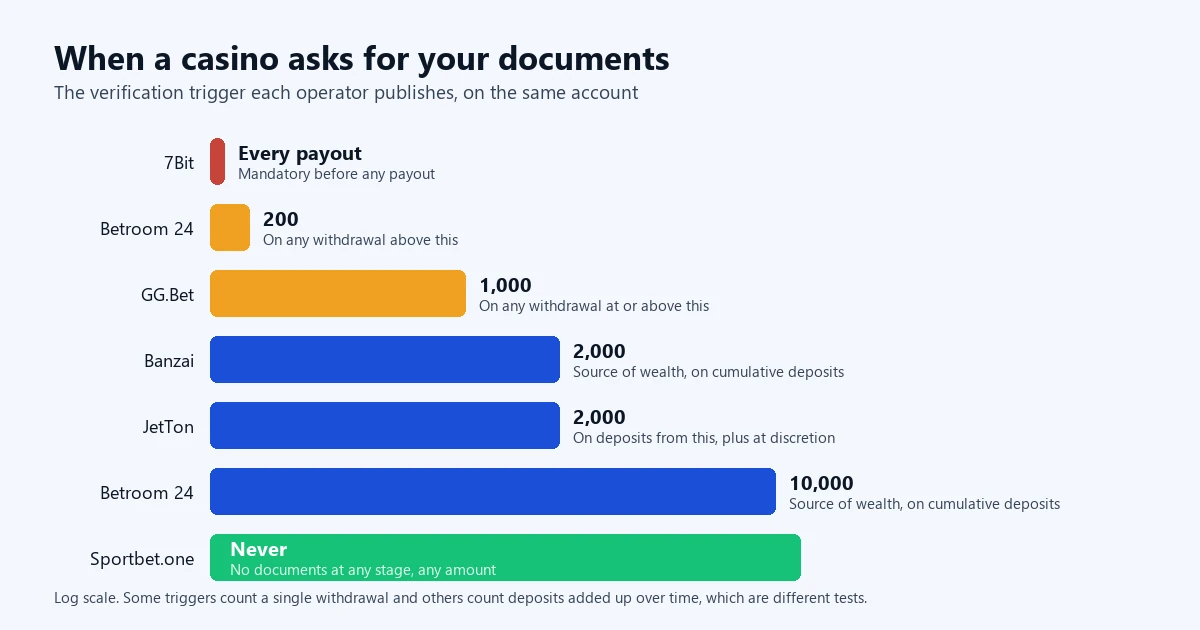
| Casino | Trigger | What it applies to |
|---|---|---|
| 7Bit | Every payout | Verification is mandatory before any withdrawal |
| Betroom 24 | 200 | Any withdrawal above it, and any withdrawal of unwagered funds |
| GG.Bet | 1,000 | Any withdrawal at or above it, plus an optional video call |
| Banzai | 2,000 | Source of wealth and funds, on cumulative deposits |
| JetTon | 2,000 | Deposits from that figure, plus at the platform's discretion |
| Betroom 24 | 10,000 | Source of wealth and funds, on cumulative deposits |
| TG.Casino | At discretion | Photo ID, address confirmation and a selfie, no threshold published |
| Sportbet.one | Never | No documents at sign-up, deposit or withdrawal, any amount |
Each trigger read from that operator's own published terms during its review, in the currency the operator uses.
The spread across that table is fifty-fold before you reach the operator that never requests documentation. A player withdrawing 500 hands over documents at three of these casinos and nothing at the other four, on identical money.
Withdrawal triggers and deposit triggers are different tests
The column that determines whether a threshold applies to you is the one nobody reads. There are two different structures in use, and they behave in opposite ways.
- A withdrawal trigger fires on a single transaction. Below it, nothing happens. Betroom 24 at 200 and GG.Bet at 1,000 both work this way, so splitting a large payout into smaller ones might in principle avoid it, except that the monthly ceilings and the anti-structuring clauses both exist to stop exactly that.
- A deposit trigger fires on a running total. Banzai's source-of-wealth check starts once cumulative deposits pass 2,000, whether that arrives in one payment or in forty. A regular small-stakes player crosses it eventually without ever making a large transaction.
The second structure is the one that surprises people, because based on each individual deposit nothing looks like it should attract attention. Someone depositing 50 a week reaches Banzai's threshold inside a year, and Betroom 24's 10,000 source-of-wealth line after about four.
JetTon adds a third consideration worth noting: KYC may be required from 2,000 of cumulative deposits, and at the platform's discretion at any other time. A discretionary clause sitting behind a published threshold means the threshold is a floor rather than a rule.
The one genuine no-KYC casino on this site
Out of the 88 casinos in our database, exactly one publishes a policy that holds up on reading the terms.
Sportbet.one maintains that it does not require identity verification at any stage: not at sign-up, not at deposit, and not at withdrawal, regardless of the amount. The terms go beyond the customary wording, saying that where cheating or bonus abuse is suspected, verification "is conducted using behavioral and account activity data only; the company does not require, collect, or rely on identity documents or other personal identification information as part of this process". Our Sportbet.one review quotes the clause in full.
Two things are worth noting about that, because a no-KYC policy is a trade-off rather than a benefit.
- It works because the licence is light. A Mwali licence imposes far less than Malta or the Curacao Gaming Control Board would, which is what leaves room for the policy at all.
- No document check also means no regulator with teeth. The same absence that removes the paperwork removes the body that could compel a payout if one were withheld, as our licence checking guide sets out.
Choosing a casino for its verification policy is necessarily choosing a licensing position at the same time, whether intentionally or unintentionally.
Where a "no verification" promise gets undone
The more common practice is a marketing claim that the terms qualify at a low figure, and Betroom 24 best illustrates this in our reviews.
The site claims no verification as a headline benefit. The terms then state that verification is always carried out for withdrawals over 200, and for any withdrawal of funds that were not used for wagering. Two hundred is a small amount: any winning session at all crosses it, and depositing without playing crosses it immediately.
Neither statement is untrue by itself. A small withdrawal from an account that has been used for gambling does go out without documents, which is the headline case. The qualification is simply stated in a different document from the promise, which is consistent with every other clause in our bonus terms guide.
TG.Casino sits at the other end of the honesty spectrum on this issue. Its terms state that photo ID, address confirmation and a selfie may be requested, and it makes no no-KYC claim anywhere. Reserving the right without publishing a threshold is less helpful than a number, and it is at least consistent.
The check that happens before casino KYC does
Operators determine where you are before any document is requested. Restricted country lists are the first filter, they are published in the general terms, and most people are surprised by their length.
| Casino | Licence | Countries excluded |
|---|---|---|
| Sportbet.one | Mwali | 5 |
| Quickz | Malta | 33 |
| TG.Casino | Not disclosed | 34 |
| Fairspin | Anjouan | 67 |
| SpinLander | Anjouan | 171 |
Counts taken from each operator's own published terms during its review. SpinLander's 171 is more than most people would guess exist as options in the first place.
The list that catches European readers is Fairspin's, because it excludes 24 of the 27 EU member states. Quickz, on a Malta licence, excludes 33 countries with no EU member state among them, which is a licence condition operating as a practical difference.
Being on a restricted list is a worse problem than failing verification, because it surfaces late. A site loads normally, registration succeeds, a deposit clears, and the country check runs at the withdrawal alongside the document check. By that point the balance exists and the account should never have been opened.
The one-minute version: look for the restricted list in the terms before depositing, and look for your own country in it. It is usually a single long paragraph or an alphabetical list, and it is the cheapest check on this page.
The casino KYC document list
The requests come in tiers, and each tier is triggered by a different concern.
| Tier | What is asked for | What it establishes |
|---|---|---|
| Identity | Government photo ID: passport, driving licence or national card | That you are a real, adult person |
| Address | A utility bill or bank statement, usually under three months old | Which jurisdiction's rules apply to you |
| Payment method | A card photo with digits masked, or a wallet screenshot | That the money is going back where it came from |
| Source of funds | Payslips, bank statements, sale documents | Where the money you are gambling came from |
| Liveness | A selfie, and at one casino a video call | That the person holding the documents is you |
Compiled from the document lists published by the casinos reviewed on this site. The first three tiers are near universal; the last two appear above a threshold.
Source of funds is the tier people find most intrusive, and it is also the one an operator has the least control over. It is a mandatory obligation rather than a discretionary one, which is why the thresholds cluster: 2,000 at two of our casinos, 10,000 at another.
One newer clause is worth highlighting. Slotoro's terms prohibit AI-altered or otherwise manipulated verification documents in unusually explicit language, which is a signal of what the industry is now seeing. Submitting an edited document is grounds for closing an account and forfeiting the balance everywhere we have checked, and it is not a grey area.
The frozen account that becomes a dormant one
This is by far the most expensive verification clause we have come across, and it is a single sentence long.
At TG.Casino, an account frozen for 180 days because verification documents were not supplied is treated as dormant, and charged on the same schedule as any other dormant account: 10% of the remaining balance every month. As a result, a player who cannot complete verification watches the held balance shrink while the hold is in place.
Nothing about that is concealed and both clauses are published. The point is that they interact, and the interaction is not stated anywhere: one clause freezes the account, another charges idle accounts, and nothing tells the reader that the first triggers the second. Our dormant account fees guide sizes those charges against a real balance.
The lesson is narrow and worth acting on. If a verification request arrives, either answer it or close the account, because leaving it unanswered is not a neutral option at every operator.
Making casino KYC painless
- Verify at sign-up. Before there is a balance waiting on the outcome, and before any deadline is attached.
- Photograph documents flat, in daylight, all four corners visible. Most resubmissions are caused by a cropped edge or a glare spot rather than by anything substantive.
- Match the name exactly. The account name, the document and the payment method all have to agree, and a middle name missing from one of the three causes a rejection.
- Use a payment method in your own name. A card belonging to somebody else fails at this stage everywhere, however innocent the arrangement.
- Keep a proof of address under three months old. It is the document people are least likely to have to hand.
- Never edit anything. Including straightening or brightening, if it touches the data. Send a worse photo instead.
Done at sign-up, the whole exercise takes about ten minutes and never comes up again. Done at withdrawal, it takes the same ten minutes plus however long the operator's queue is, on top of the monthly ceilings covered in our withdrawal limits guide.
Casino KYC questions
The identity check an operator runs before a payout: government photo ID, proof of address, and above a threshold, proof of where the money came from. It is a licence requirement rather than an operator preference.
It varies fifty-fold. Published triggers in our reviews include every payout, a withdrawal of 200, a withdrawal of 1,000, and 2,000 of cumulative deposits. See the full comparison.
One of our 88 publishes a policy that holds up on reading the terms: no documents at any stage, any amount, with abuse investigated solely on account activity. See the clause.
Operators have to comply with anti-money-laundering rules on who they are paying, and a licence makes it a condition. The check is legitimate; the delay is caused by it arriving at withdrawal instead of at sign-up.
Photo ID, then proof of address, then proof of the payment method, then above a threshold, proof of source of funds. One casino also reserves the right to a video call. See the tiers.
An operator can hold the withdrawal indefinitely, and at one casino an account frozen 180 days for missing documents is then charged the dormancy fee on the held balance. See how those clauses interact.
Documents usually take 24 to 72 hours to process once readable ones arrive, and much longer if anything is resubmitted. One casino publishes that verified accounts can be paid immediately.
No. At least one casino now has a clear policy prohibiting AI-altered or manipulated documents, and submitting one is grounds for closing the account and forfeiting the balance everywhere we have read.
Read next
- Withdrawal limits and fees - the ceilings that apply once verification is complete.
- How to check a casino licence - the licence that decides how heavy the verification is in the first place.
- All casino bonus guides - one page per clause, with the figures the reviewed casinos publish.
About the author

Ana Petrescu
Bonus terms editor, CasinoFinderHub - Bucharest
Our crypto page used to hedge on this subject, saying verification requirements usually surface at withdrawal regardless of what a site claims. Reading Sportbet.one's terms in full is what made me stop hedging, because one operator really does publish the policy it advertises.
The finding I did not expect was the deposit-side trigger. A withdrawal threshold is visible and avoidable; a running total of deposits is neither, and a modest regular player crosses it without ever making a transaction that looks large. That is the clause I would check before the headline.
Play safely
A verification check slows things down rather than intruding, and the account it safeguards is yours. It is also a natural pause: the moment a casino asks for a payslip is an appropriate moment to think about how much has gone through the account this year.
Deposit limits are usually found in the same settings menu as the verification page. Free, confidential help is available from BeGambleAware, Gambling Therapy and Gamblers Anonymous.
18+ Gambling is for adults only. Online casino play is not legal everywhere, so check the rules where you live before registering anywhere.
Every threshold and clause on this page was read from that operator's published terms during its review, between June and August 2026, and each review carries the date. Figures are given in the currency each operator publishes them in, and operators amend these documents without notice.